

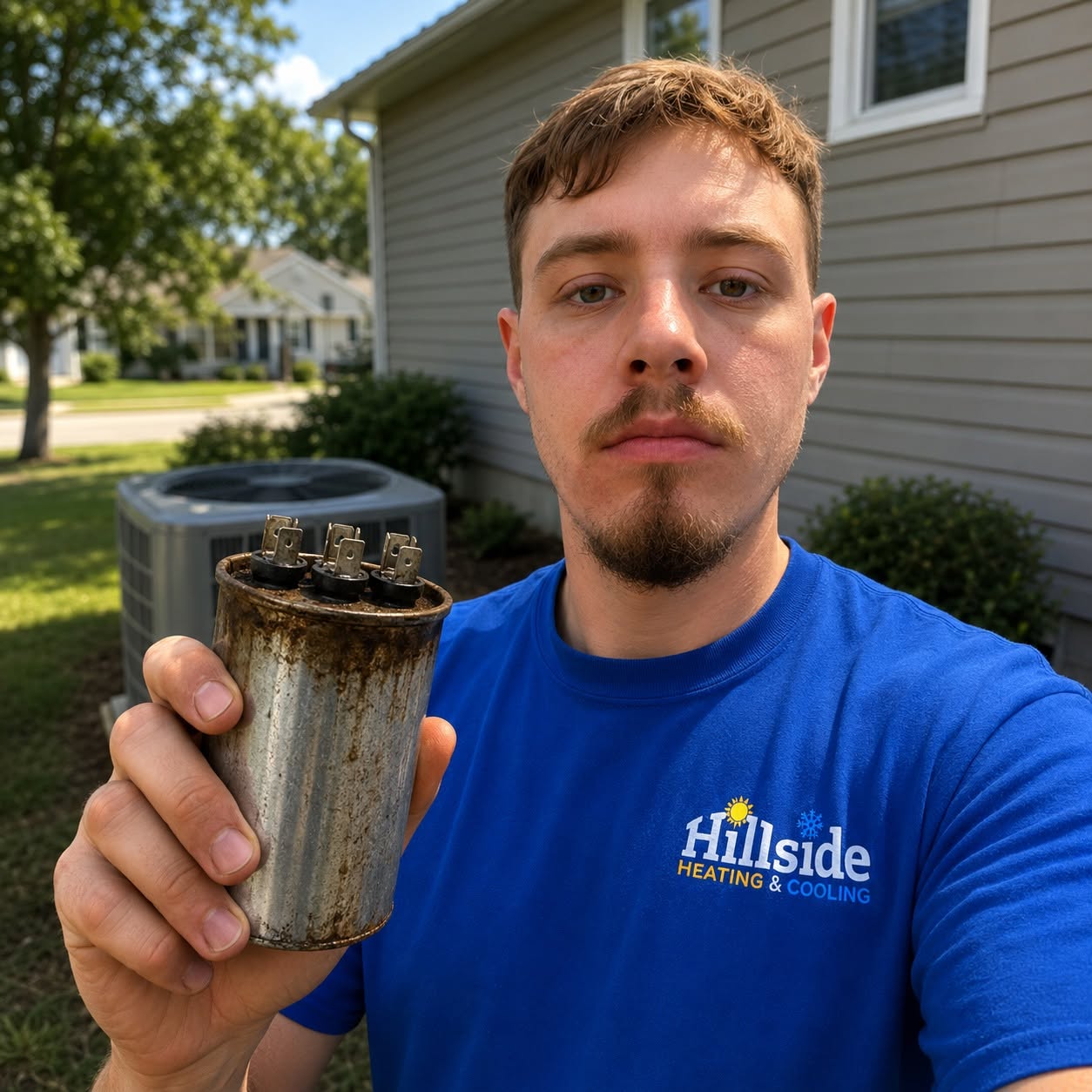
Outdoor AC Unit Humming but Fan Not Spinning?
If your outdoor air conditioner or heat pump sounds like it wants to start but the fan is not spinning, the problem may be a small electrical part with a big job: the capacitor.
When a cooling system stops working, many homeowners immediately worry about a failed compressor, a burned-out fan motor, or a full system replacement. Sometimes the issue is simpler than that.
An AC capacitor helps give the compressor and condenser fan motor the electrical boost they need to start. If it weakens or fails, your outdoor unit may hum, buzz, click, or sit there doing almost nothing while your home keeps getting warmer.
For homeowners across New Castle County, DE, Cecil County, MD, and Southern Chester County, PA, this is a common kind of summer service call and a good reminder that electrical HVAC issues should be tested safely before more damage occurs.
What Is an AC Capacitor?
An air conditioner or heat pump capacitor is a small electrical component that stores and releases energy. Think of it like a temporary power booster for the motors inside your HVAC system.
Your outdoor unit relies on motors to operate the compressor and condenser fan. These motors need an extra surge of electrical energy to start. The capacitor provides that boost at the right moment so the system can begin running.
In many central air conditioners and heat pumps, the outdoor unit may use a dual-run capacitor, which helps both the compressor and the condenser fan motor. Some systems use separate capacitors for different components.
Without a properly functioning capacitor, the motor may struggle to start, run weakly, make a humming sound, or fail to operate at all.
What Does the Capacitor Actually Do?
The capacitor helps your HVAC system in two important ways.
- It helps the motor start. Motors inside an air conditioner require more energy to begin moving than they do to keep running. The capacitor gives the compressor or fan motor the extra electrical push it needs at startup.
- It helps the motor run efficiently. A weak capacitor can cause the motor to work harder than it should. That extra strain can lead to overheating, poor cooling performance, higher energy use, and additional wear on the system.
In simple terms, the capacitor helps your AC or heat pump start smoothly, run properly, and avoid unnecessary stress on major components.
Why Do AC Capacitors Fail?
Capacitors are common failure points because they work under demanding conditions. They are exposed to high electrical loads, outdoor temperatures, vibration, humidity, and years of normal system operation.
- Heat exposure. Outdoor AC units sit through hot summer temperatures, and the internal components also generate heat while the system is running.
- Age and wear. Capacitors naturally weaken over time and can lose their ability to hold the proper electrical charge.
- Power surges or electrical fluctuations. Storms, utility issues, or sudden changes in electrical supply can damage sensitive HVAC components.
- Overworked motors. If a fan motor or compressor is struggling, it may place extra demand on the capacitor.
- Corrosion or weather exposure. Because the outdoor unit sits outside year-round, moisture and weather can contribute to electrical issues over time.
A failed capacitor does not always mean your entire HVAC system is in bad shape. But it does mean the system should be inspected before the problem causes additional damage.
Signs of a Bad AC Capacitor
A failed or weak capacitor can show up in several ways. Homeowners may notice:
| Symptom | What It May Mean |
|---|---|
| Outdoor unit hums or buzzes but does not start | The motor may be trying to start without enough electrical boost. |
| Fan is not spinning | The condenser fan motor may not be receiving the help it needs to start. |
| AC turns on and off quickly | The system may be struggling to complete a normal cooling cycle. |
| Warm air from vents | The compressor or fan may not be operating correctly. |
| Burning smell or clicking noises | Electrical components may be overheating or failing. |
| Breaker trips | The system may be drawing too much current because a motor is struggling. |
The classic sign is an outdoor unit that hums but the fan does not spin. However, this symptom is not always caused by the capacitor. A bad fan motor, contactor, wiring issue, or compressor problem can create similar symptoms. That is why proper testing matters.
Why You Should Not Try to Replace an AC Capacitor Yourself
Although a capacitor may look like a simple part, it can be dangerous to handle. HVAC capacitors can hold a high-voltage electrical charge even after the power to the system has been turned off.
Replacing the part without proper testing can also lead to the wrong diagnosis. If the capacitor failed because another component is overworking, simply replacing the capacitor may only provide a temporary fix.
A technician should confirm the capacitor rating, test the electrical components, inspect the motor and wiring, and make sure the system starts and runs safely.
Local Cooling Systems Work Hard Here
Across Newark, Wilmington, Bear, Middletown, Elkton, North East, Kennett Square, Oxford, and nearby communities, cooling systems work through hot, humid summers and shoulder-season heat pump cycles.
That local weather pattern matters. Long run times, heat, moisture, and electrical stress can all contribute to capacitor problems. If your system has been starting hard, making a new buzzing sound, or struggling to keep up, it is worth scheduling air conditioning repair before a small electrical issue creates more strain on the fan motor or compressor.
How Hillside Resolves Capacitor Problems
When Hillside responds to an air conditioner or heat pump that is humming, buzzing, or failing to start, the goal is not just to replace a part. The goal is to identify the cause of the problem and restore safe, reliable operation.
- Shut down and secure the system safely. Before inspecting electrical components, the technician makes sure the unit is safely powered down.
- Test the capacitor. The technician checks whether the capacitor is holding the proper charge and compares the reading to the manufacturer’s required rating.
- Inspect related components. Hillside also checks the condenser fan motor, compressor, contactor, wiring, and electrical connections.
- Replace the capacitor with the correct part. If the capacitor has failed, Hillside installs a properly rated replacement that matches the system’s specifications.
- Restart and verify system performance. After the repair, the technician confirms that the fan and compressor start correctly and the home is cooling as expected.
- Look for underlying causes. If a capacitor failed prematurely, Hillside checks for signs of overheating, motor strain, poor airflow, electrical issues, or other conditions that could lead to repeat failures.
Can Maintenance Help Prevent Capacitor Problems?
No maintenance visit can guarantee that an electrical component will never fail, but routine service can help catch weak performance, dirty coils, airflow problems, loose electrical connections, and other conditions that make the system work harder.
If you want fewer surprises during cooling season, ask Hillside about an air conditioner tune-up or compare Hillside’s maintenance plans. If your home uses a heat pump, Hillside can also help with heat pump service for year-round comfort.
Frequently Asked Questions About AC Capacitors
Why is my outdoor AC unit humming but the fan is not spinning?
A failed or weak capacitor is one possible cause because the fan motor may not be getting the electrical boost it needs to start. A bad fan motor, contactor, wiring issue, or compressor problem can create similar symptoms, so the system should be tested.
Is an AC capacitor safe to replace myself?
No. HVAC capacitors can hold a high-voltage electrical charge even after the system is turned off. A trained technician should safely discharge, test, and replace the capacitor with the correct rating.
Does a bad capacitor mean I need a new air conditioner?
Not always. A capacitor failure can be a repairable electrical issue, but the technician should also check the fan motor, compressor, wiring, contactor, airflow, and related electrical components to make sure there is not a deeper problem.
Final Takeaway
A failed capacitor may be a small problem, but it can stop your air conditioner or heat pump from working when you need it most. If your outdoor unit is humming, buzzing, or struggling to start, do not ignore it.
The sooner the issue is diagnosed, the better chance you have of avoiding additional damage to the system.
Your Local Cooling Repair Team
Hillside Oil Heating & Cooling helps homeowners across New Castle County, DE, Cecil County, MD, and Southern Chester County, PA with AC repair, heat pump service, tune-ups, and maintenance.
Outdoor unit humming but not running? Call Hillside at 302-738-4144 for DE & PA or 410-398-2146 for MD, or contact us today!